
By Gaynor.
At the end of our first week in Sardinia, climbing around the towns of Iglesias and Domusnovas, it was time to move on to a new area. Our second destination was up in the hills, the Sardinian Mecca of climbing – Ulassai. We arrived in the early afternoon and found a colourful hill-side town set against the most amazing rock we have seen on this trip. Large outcrops loomed above us, a mixture of grey and orange limestone filled with flakes, cracks and grooves, an assortment of features that called out to be climbed. Directly behind our apartment was the Torres de Venti sector, prominently displaying a long arête which looked immaculate. We had barely finished our apartment check-in, before Jon was back out the door to go and investigate it. The signature line up the arête really inspired him.
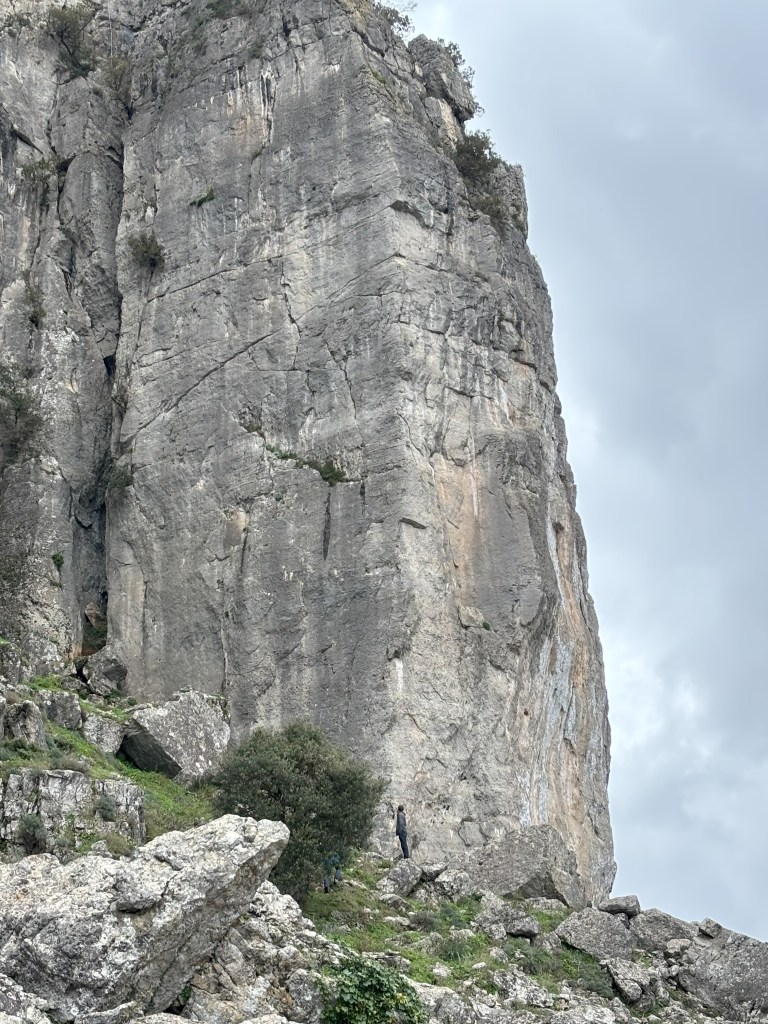
It rained heavily after our arrival, and the next day we waited until mid-morning before venturing out, giving the rock time to dry. The very helpful owner of the Dirtbag climbing shop suggested that the Bauarena sector was likely to be dry, so we headed off in that direction. Bauarena is a very extensive, and impressive rock face. South facing it glowed in the sunshine, towering above the woodland which covers the hill leading up to it. It looked stunning and was indeed dry. However, after walking up the hill to the base of the crag it became apparent that the strong westerly wind was a force to be reckoned with, and too much for us to enjoy that reckoning. Being buffeted by 70km/hr gusts whilst holding on to tiny crimps did not sound like fun. We continued to walk around the base of the massif and past other, equally windy areas, until we reached the westerly facing Su Casteddu sector. Our hope was that this would be sheltered from the worst of the wind due to the lee effect, but this was not to be. At the base of the routes the wind wasn’t too bad, but as soon as we started climbing we were being blown about and all sense of calm, relaxed, climbing went out the window. We did a couple of short 6a routes at the edge of the crag, very much in the wings of the main stage, and then beat a hasty retreat to the apartment.

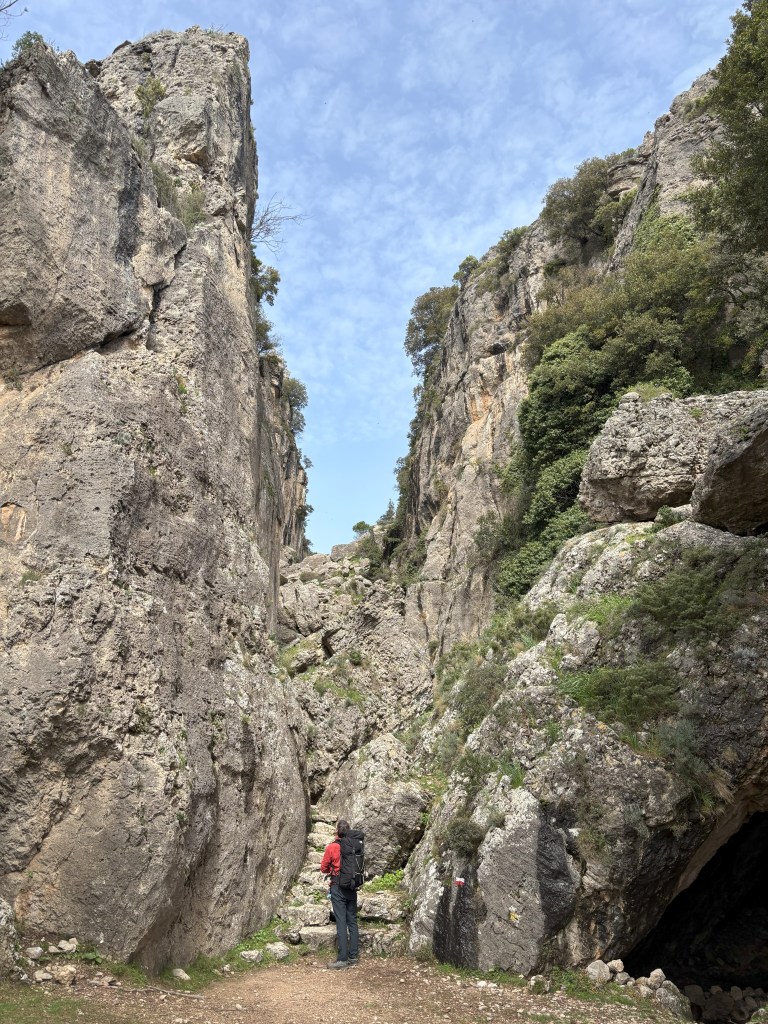
On the second day, after a dry night, we decided to check out the Canyon Sa Tappara, which sits just above the town and is renowned for its high quality, hard routes. We were hoping that it would be sheltered from the still strong westerly winds and give us something that we could “get stuck in to”. Entering the canyon is an experience in itself. Walking up the side of the hill on the edge of town you approach an obvious canyon with two walls looming up facing each other, the entrance barred by a jumble of large boulders. After ducking under a huge rock, trying not to get stuck by the rucksack on my back, we emerged into an area of calm and tranquillity. And damp. It was immediately apparent that many of the steeper routes were seeping after a winter of rain, and the easier angled rock was still wet from the recent downpour. We continued through the canyon in awe at the quality of the rock and the routes that were possible, but getting more and more demoralised by how wet it all was.
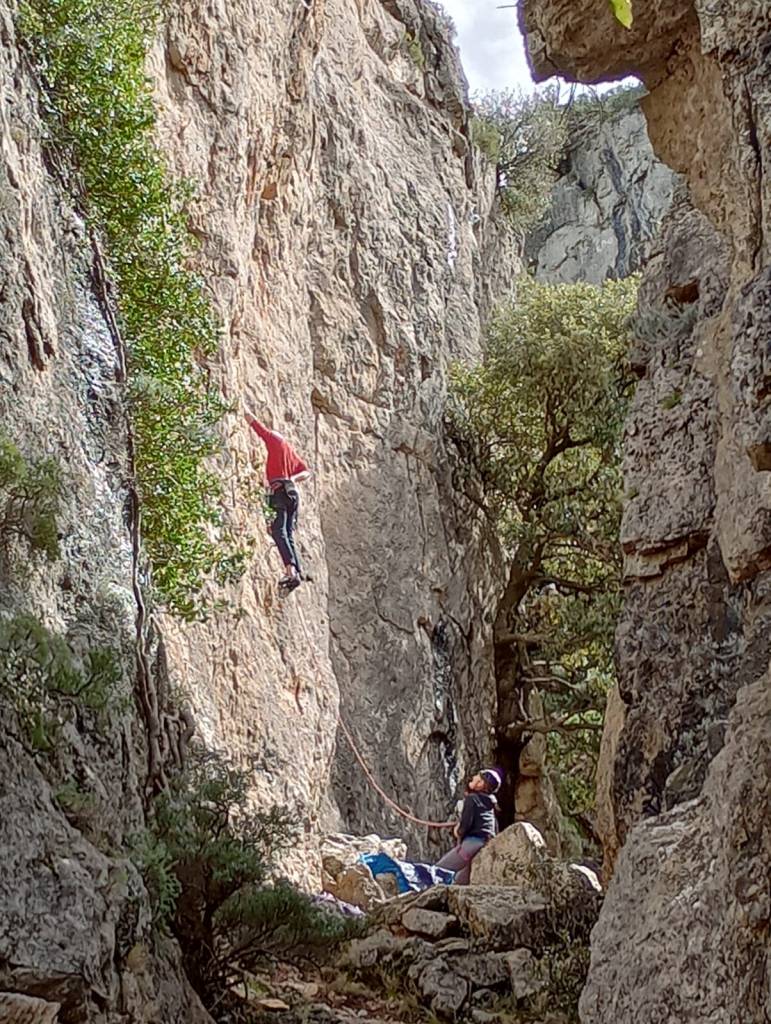
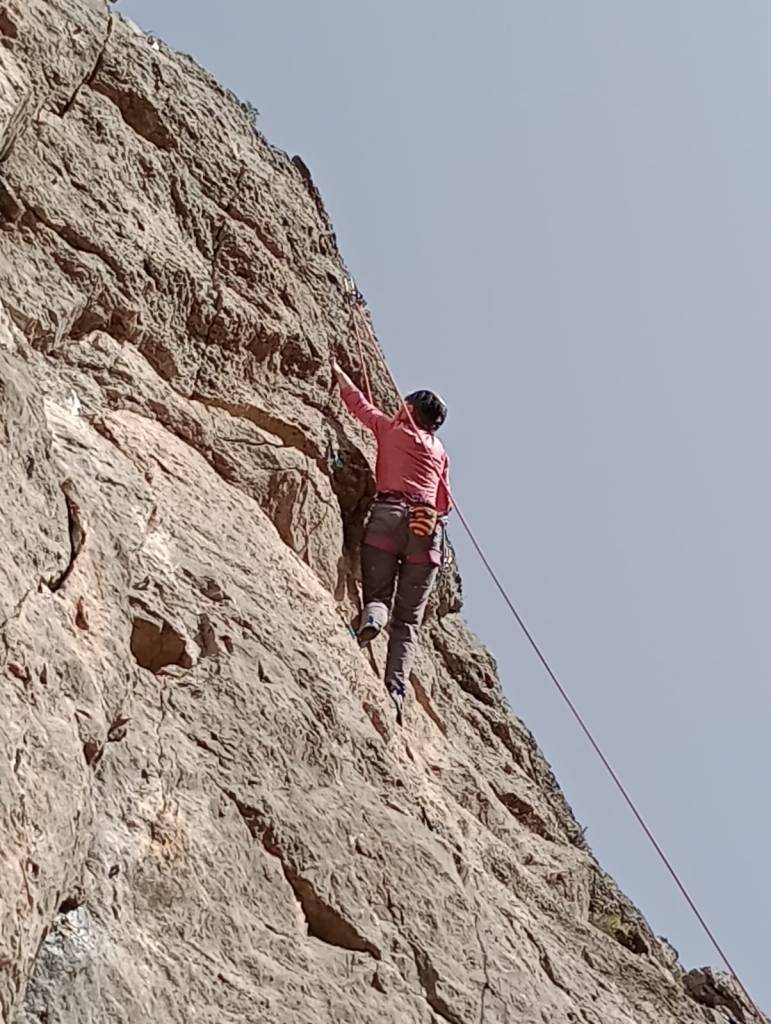
We eventually found some dry rock at the end of the canyon, a nice west facing sector with a few easier graded routes. Jon and I started on a 6a wall climb (Giolla). Just off vertical it looked fairly straightforward, with the advantage of a large fin of rock, sitting alongside the main face, giving an extra source of handholds up the middle third of the route. At least, that is what I thought. When Jon arrived at this fin of rock, it quickly became apparent that it was not covered in extra holds, it was the hold. Jon managed to make short work of it, but when I arrived at the same point it became a battle of wills. My only option was to shove my whole body in between the main face and this fin of rock. The gap was wide enough for me to fit in easily, which also meant it was wide enough for me to slip down, but not wide enough for me to move my limbs and use any of the features on the wall while I was in there! I ended up doing pull-ups with my fingertips and then twisting my hips to jam them between the rock to move my hands again. My feet were scrabbling away below me trying to get purchase on anything they could feel which I could not see. It was hideous, and utterly exhausting. I emerged from the top of the chimney puffing like a steam train, having used language that rarely passes my lips. A few more moves and I reached the anchors, relieved that the experience was now over and swearing never to repeat that route again! Unfortunately, I expect that route will stay in my memory for much longer than any of the other more enjoyable routes that I have climbed on this trip! With my ego feeling battered and bruised after that experience, we moved onto a 6b beside it (Cicciasaura), slightly wary of what the canyon was going to offer us this time. It turned out to be a delightful route, with lovely, flowing moves, and I climbed it with the sun gently warming my back and taking the chill off the air. It was the perfect antidote to the previous experience.
The weather was not our friend in Ulassai. During our 11 days there we managed to get on the rock 4 times, only once managing more than two routes before being forced off by the weather (wind, rain, cloud, we had it all). I think we were there about a month too early in the season, but we were also unlucky. The week before our arrival the weather was perfect which gave us very high hopes. The hardest challenge was dealing with the boredom, cooped up in an apartment with not much to do in a remote location. Even going for walks is not much fun when the weather is so bad.
Ulassai is an inspiring place for climbers, but to get the most out of it one needs to be climbing grade 7 comfortably. There are significantly more routes graded 7 and 8 than there are 5 and 6. So for us, it did feel like we were on the edge of things, trying to find the easier routes to warm up on, and never getting the chance to get onto the harder routes to work them. However, most of the easier routes that we did were of high quality, and certainly the 6a that I led in Bauarena (Spoonetti) had lovely moves and was very considerately bolted, ideal for someone like me who does not often lead.
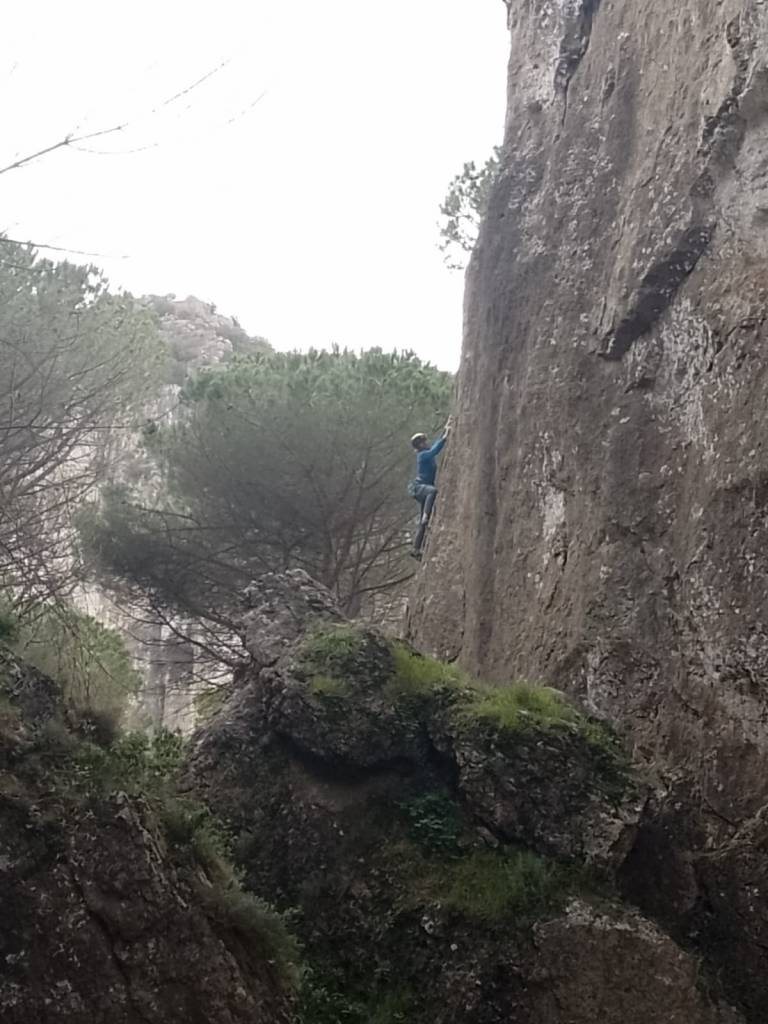


Would we go back there? That is so hard to say whilst we are still processing the disappointment from what was meant to be the key part of this trip. I would not return in March, but I would not be against coming back another time, when the weather is likely to be more stable, perhaps in the latter half of the year when seepage is less of a problem. There is just too much to do on fantastic looking rock, and for me, one of the principal attractions is that so many of the routes are technical and crimpy, not just steep, overhanging pump-fests that require strength above all else. But that also seems to be one of the defining characteristics of the rock on Sardinia, it creates beautiful, technical routes, which are a joy to climb. They are engaging both physically and mentally.
Our next stop is the east coast area around Baunei, hopefully there will be more of the same quality rock and routes, but with better weather!
 Ordinary Climbers
Thank you, shame about the wether, but stunning area, onto the next adventure…. Great information regarding an area I know nothing about.
Paul
LikeLike
Hi Jon and Gaynor,Hope you are both well.I really enjoy reading your climbing blogs! Lovely to hear from you.I’ve been wondering where you have been and whether you would resume your climbing expeditions after the pandemic. That Bauarena crag is impressive and reminds me of the very long reef limestone ridge just east of La Villa in the Dolomites where we had a couple of lovely walking holidays in 2017.https://maps.app.goo.gl/bhoHexrajFxrcA5A8?g_st=amHighest point on this ridge is Monte Cavallo I believe.https://maps.app.goo.gl/V8S1fkhLj3dNEiWr7?g_st=amLots of via ferratas in that area if you like those…Looking forward to more of your blogs.!!Take careDavid Hood
LikeLike
Hi Dave
Thanks for the message, it is lovely to hear from you. I am glad you enjoy the blogs, I do often wonder if anyone actually reads them! We are both well and enjoying living in France. I hope all is well with you.
Take care,
Gaynor
LikeLike
We were there the same time, but we stayed almost 2 months. From April the weather got better and we had a great climbing experience. Canyon Sa Tappara is where we spend the most of our time and it was just perfect. Other great crags we visited are Su Casteddu, S’assa bella and Torre dei venti. We also visited the crag of Pallazo d’inverno in the next village of Jerzu. You guys did a great job reviewing the place whilst the weather was “off”. Hope you have more luck the next time 😉
LikeLike
Thanks for the comment! I am glad the weather improved for you, the forecast looked great as soon as our ferry departed 😆. I hope we get the chance to go back, the rock was so inspiring!
LikeLike
Hi Dr. Gaynor,
I have enjoyed your blogs so much. I met you once in LAS VEGAS in 2011, or 2012 when I was student at the time. All best wishes! Hesham from Libya
LikeLike